Stronger Together: Supporting Indigenous-Led Conservation

Indigenous-led Conservation
Becoming a better ally to protect the land, freshwater, and ocean we love.
Walking through your favourite spots in nature, you may notice changes — fewer birds, less fish, cut trees, or more litter. Do you worry what it will look like after another decade of climate change and human presence? Maybe you’re already trying to protect these areas and feel you’re facing the challenge alone.
But you’re not alone. According to recent surveys, more than half the country is worried about our natural ecosystems, including neighbours who have lived in this landscape for thousands of years – who understand its patterns, stories, and ways of healing. Their knowledge and commitment are vital teachings for protecting and restoring the natural environment. This is essential to holistic and successful conservation.
Indigenous-led conservation is critical to effective nature protection because it recognizes the key role and decision-making function of the traditional stewards and prevents repetition of past harmful conservation efforts that removed Indigenous Peoples from their land. How we support Indigenous-led conservation matters. At CPAWS, we believe that the greatest conservation successes occur when we work together to support Indigenous partners, building on a foundation of shared goals and mutual respect.
That’s why we recently completed a project to learn how to be a better ally in the important movement of Indigenous-led conservation. Through surveys with Indigenous practitioners, conversations with specialists at organizations including the Metis National Council, Parks Canada, and others, and internal reflection within CPAWS, we gathered crucial insights into what true partnership with Indigenous people requires.
But first: why an Indigenous-led approach to conservation matters
Conservation today faces more challenges than ever — funding gaps, policy pressures, and capacity constraints. When governments prioritize development over protection, the places we love become vulnerable. We heard that when Indigenous leadership is centred, we can break down barriers and create solutions together, using:
- Shared Expertise – combining legal knowledge, technical skills, and communication networks for greater impact.
- Stronger Voices – united advocacy carries more weight than scattered efforts. Decision-makers listen when diverse voices speak together.
- Innovative Approaches – Together, Traditional Indigenous Knowledges and Western science create better environmental outcomes. Incorporating different ways of knowing ensures that all aspects of conservation are considered and addressed.
Across Canada, Indigenous-led conservation efforts are already transforming landscapes:
- Indigenous Protected and Conserved Areas (IPCAs) protect millions of acres. Indigenous laws, knowledge, organizations, and governance oversee IPCAs, weaving together cultural protection, language preservation, and environmental stewardship.
- Reducing wildfire risks: Traditional burning practices can prevent the catastrophic wildfires that threaten our communities, damage habitats, and fill our skies with smoke.
- Indigenous Guardian programs: Indigenous People are empowered to monitor the ecological health of their traditional territories, maintaining cultural sites and protecting sensitive areas and species. This creates jobs and encourages stewardship responsibilities, leading to healthier communities and ecosystems.
The role of CPAWS as an ally in this space is to support Indigenous communities in their conservation efforts. We are committed to working within a framework of reconciliation, advancing our biodiversity conservation priorities in an open and honest manner while respecting the rights and self-determination of Indigenous communities and organizations as they pursue their own economic and cultural interests.
When environmental organizations work respectfully with Indigenous Peoples, conservation becomes more resilient, effective, and enduring.

Indigenous Ally Toolkit
Check out this resource to learn how you can use your influence to support First Nations, Métis, and Inuit-led initiatives, challenge barriers, and promote equitable partnerships.
What does it mean to be a strong ally?
We heard that allyship is about how we support Indigenous-led conservation efforts by utilizing our resources to remove barriers and promote equitable partnerships. It is not a destination, but an ongoing journey of relationship building and organizational transformation, characterized by continuous learning and stepping back to allow Indigenous voices to lead the way.
Building on our ongoing practice to support Indigenous partnerships and our continued work towards reconciliation, CPAWS’ recent project on allyship has helped us understand how environmental organizations, like ours, can become better allies and unite conservation efforts. The insights gained are reflected in our guiding principles and we are working to put them into practice every day.
What we heard:
- Listen first: Rather than assuming what support is needed, let communities or Nations dictate what their actual needs are.
- Build trust over time: Meaningful partnerships are not transactional. They take years to grow through consistent relationship building, not short-term agreements or one-time projects.
- Amplify, don’t represent: Use position and influence to create space for Indigenous voices to speak louder and be heard. Don’t speak for them.
- Be transparent: Be clear about organizational priorities, capabilities, and limitations from the outset.
- Simplifying access: Make funding, information, and conservation tools easier to access, without adding unnecessary burdens.
- Learning and growing: Allyship is a journey. We are not setting a new direction — we are deepening commitments for a path we’re already on.
Allyship Themes
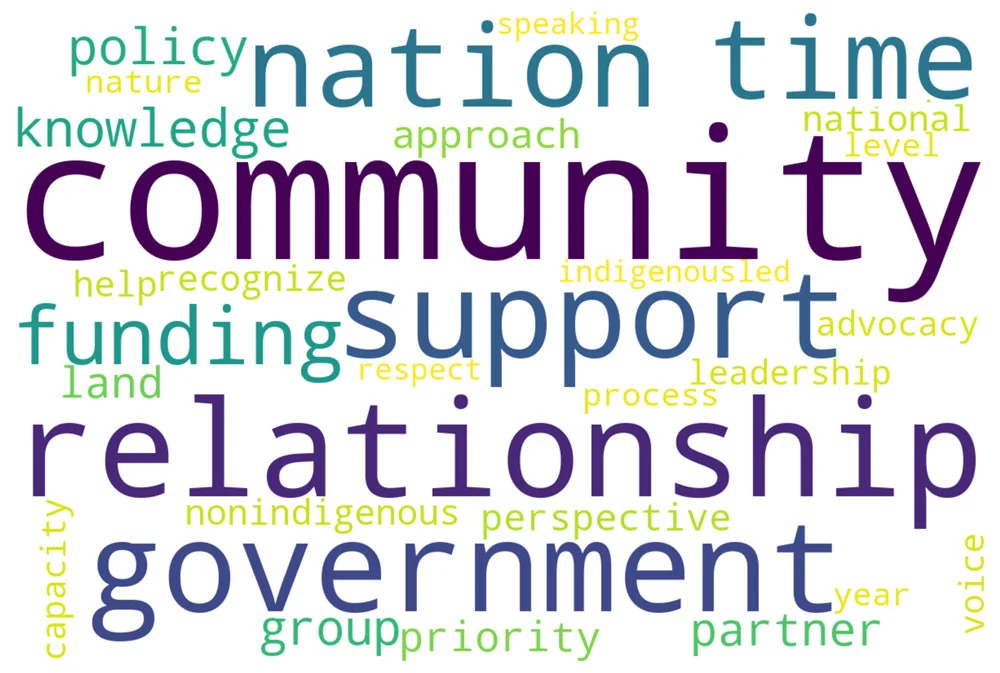
The word cloud shows the most common themes that emerged in our engagement analysis through conversations and surveys. It illustrates what matters the most in supporting Indigenous-led conservation, including
- Community: Partnerships must prioritize local Indigenous needs over external organizational agendas while respecting community- or Nation-specific priorities.
- Relationships: Meaningful partnerships must be nurtured over the long-term with consistent support.
- Government and Support: Environmental organizations can push for systemic change by opening doors and helping Indigenous communities and leaders gain access to decision-making spaces, rather than acting as intermediaries.
Strength in Togetherness
Meaningful Indigenous conservation partnerships benefit everyone nationwide, providing cleaner water, healthier wildlife populations, stronger climate change resilience, and a more diverse and protected cultural heritage. CPAWS remains committed to ongoing learning, deepening relationships, and improving as an ally.
As you continue to wander and appreciate the natural world around you, remember that protection is a joint effort. Consider connecting with your Indigenous neighbours to honour their knowledge, learn about their conservation efforts, and support their work.
By walking together — Indigenous and non-Indigenous people — we can cultivate a future where nature and humans thrive, together.
Other articles you might be interested in:
-
 Climate Change, Indigenous-led Conservation
Living with Fire: Rethinking Wildfire Resilience in Canada
-
 Coasts and Ocean, Indigenous-led Conservation
CPAWS-BC celebrates the milestone announcement of the Mia-yaltwa Ha’lidzogm hoon
-
 Coasts and Ocean, Government and Policy, Indigenous-led Conservation
CPAWS-BC stands with Coastal First Nations
-
 Coasts and Ocean, Government and Policy, Indigenous-led Conservation
Still Fighting for a Seat at the Table
-
 Conservation, Indigenous-led Conservation
📢THE GRADES ARE IN. LET’S LOOK AT WHO’S LEADING CONSERVATION IN CANADA
-
 Government and Policy, Indigenous-led Conservation
COP 16: MAKING PEACE WITH NATURE
-
Biodiversity, Indigenous-led Conservation, International
COP15: A recap of news from Week 1 and sneak peek of Week 2
-
Indigenous-led Conservation
Indigenous lens needed to guide conservation
-
Indigenous-led Conservation
How Our Outdoor Educational Program is Impacting Youth and Our Communities


